Tientietnikov’s estate
Dead SoulsTientietnikov’s estate serves as a stopping place in Chichikov’s travels and a lens on rural life: its household settles into comfort, its surrounding roads and water shape movement, and its working countryside stands in contrast to the uncertain road that brings visitors to it. The estate is not only a backdrop to Chichikov’s dealings; it is a lived domestic and agricultural space, observed through the differing habits of master, servants, and animals.
Arrival and the surrounding roads
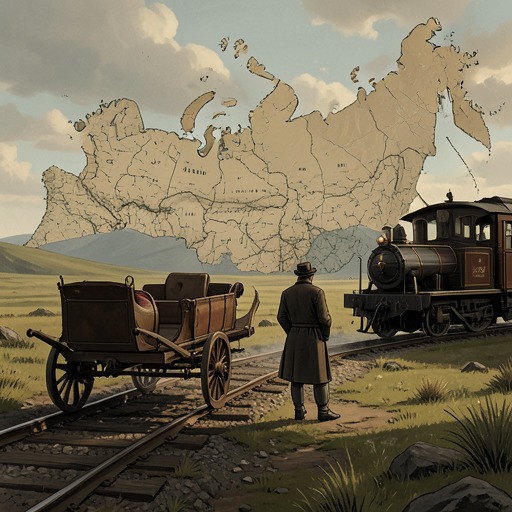
Earlier in his journey, Chichikov’s route is made uncertain by weather and bad navigation. A thunderstorm overtakes his carriage, Selifan cannot remember how many turnings they have passed, and he chooses a road without knowing where it leads. Elsewhere, sodden ground cakes the wheels with mire, while roads branch in every direction until a local girl helps Selifan find the main road. These episodes establish the practical difficulties of travel through the countryside before the estate becomes a place of rest and renewed movement.
The approach to Tientietnikov’s estate is described at a gentler pace. Chichikov’s carriage descends an incline, passes water-mills, crosses bridges, and travels over a comparatively smooth road across the flats. Aspen-studded meadows come into view; osiers, elder trees, and poplars brush the passing servants, while woodland thickens before opening onto a lake about four versts around. The landscape is worked and inhabited as well as picturesque: fishing is underway in the lake, and a peasant village lies along its far shore.
Household life
Chichikov’s servants soon make themselves at home in the mansion. Petrushka and Grigory, the butler, first compete in boasting about their travels. Petrushka recounts places he has visited; Grigory counters with Saint Petersburg, which Petrushka has never seen, and then invents a town absent from every map, placing it an extravagant distance away. The servants laugh at Petrushka’s bewilderment, but the rivalry gives way to friendship: the two swear to remain friends and begin visiting the village tavern together.
The estate offers Selifan a different pleasure. In the village, evening songs and country dances draw him among the young women and men. He dances hand in hand with the women, then joins a line of young men approaching them as the group sings. The experience lingers beyond the dance: when asleep or awake, at noon or twilight, Selifan seems still to be holding a pair of white hands and moving through the figures. The same place that provides domestic ease for the servants therefore becomes, for Selifan, a social world whose music and movement follow him in memory.
Even the horses are accommodated. Chichikov’s bay, the Assessor, and the skewbald each have a separate stall, but can see one another over the partitions and answer one another’s neighs. Their contentment with the oats and stable arrangements extends the account of comfort beyond the human household, grounding the estate’s welcome in practical provision.
Chichikov’s inquiry
The apparent domestic ease does not displace Chichikov’s purpose. At Tientietnikov’s, he decides to proceed cautiously and secretly rather than approach his host directly about the business that has brought him across Russia. Noticing Tientietnikov’s absorption in reading and philosophical conversation, he determines to begin with the servants and quietly gathers information about the household’s connections.
Their account leads him to a neighboring General, whom Tientietnikov had visited, and to the General’s daughter. The servants report that she and Tientietnikov had once been involved but later parted and went their separate ways. Chichikov has also noticed Tientietnikov’s repeated drawings of heads, each one resembling the last. The estate is thus a place where Chichikov reads both the household’s routines and its personal history for clues, while his inquiries remain concealed from the man whose confidence he is visiting.
The estate as a rural world
The novel places the estate’s local life within a broader countryside of roads, fields, villages, and agricultural work. Elsewhere, the passing view includes inns, roadside sellers, repaired bridges, pedestrians, tilled strips of land, and settlements strung along the route. Such details make travel inseparable from the condition of roads and the labor and commerce sustained beside them. At Tientietnikov’s, the meadows, mills, lake, village, and estate stables render that rural environment particular and inhabited.
The contrast between travel and residence is central to the estate’s significance. On the road, rain, mud, missed turnings, and uncertain direction can thwart the journey; within the estate, servants form attachments, the horses have assigned stalls, and the surrounding land offers recognizable routes and livelihoods. Yet this order does not erase Chichikov’s itinerant schemes: he uses the temporary security of the house to gather intelligence. Tientietnikov’s estate consequently holds together two modes of rural existence—the settled rhythms of household and landscape, and the guarded, opportunistic movement of the visitor passing through them.